A Window Seat at Dusk: Seeing a Room from One Fixed Viewpoint
A window-seat dusk observation helps you notice how fading light, distance and framing change one familiar room without moving your viewpoint.
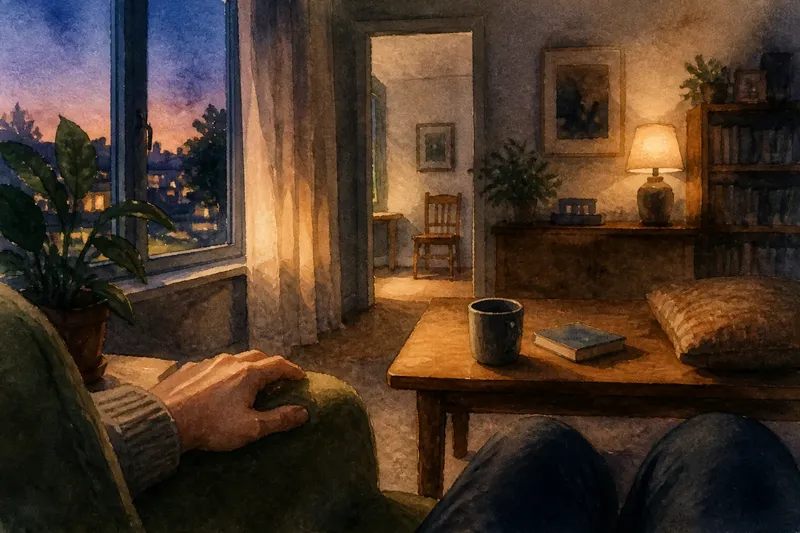
A window-seat dusk observation works best when you keep your seat and let the room change around you. Settle somewhere you can see both the window and part of the room, then watch how fading light, distance and the edges of your view alter what seems near, prominent or connected. The exercise is quiet, but it is not always easy: glare can distract, familiar objects can disappear into the background, and the urge to get up for a better angle can take over.
Those snags are useful to notice. The point is not to produce a perfect picture of the room; it is to see what this particular viewpoint makes available, and what it leaves out. If you have a comfortable chair by a window, a sofa arm or even a cushion on the floor, you have enough. Choose a seat you can stay in without straining, and begin with the view as it is.
Why does the room look flat from the window seat?
When several objects seem to merge into one plane, it is often because their outlines overlap from your seat. A plant may line up with a lamp, or a bookcase may appear to touch the edge of a doorway. From elsewhere, those things are separate; from here, the view compresses them.
Stay put and choose one clear object in the foreground, such as the arm of your chair. Then follow its outline towards something farther away: a table, a doorframe or the opposite wall. Notice where one shape ends and another begins. You are not trying to correct the overlap. You are learning how this seat combines separate parts into a single visual arrangement.
If the view still feels like a flat inventory, stop naming objects and look for the gaps between them. A strip of wall between a plant and a cabinet, or a wedge of floor beneath a table, can reveal distance more clearly than the objects themselves. Let your eyes rest on that open area for a moment, then notice which surfaces sit in front of it.
What if dusk turns familiar objects into dark shapes?
As daylight fades, colour and small details become harder to read. A chair that looked blue earlier may now appear almost black, while its outline remains clear against a pale wall. That shift can make the room feel unfamiliar, even though nothing has moved.
Rather than straining to recover a colour, pay attention to contrast. Which edge still catches light? Which object blends into the wall? A pale curtain may hold its shape after the darker window frame becomes difficult to distinguish. The room has not simply become dimmer; different surfaces are losing definition at different rates.
If your eyes feel tired, turn on a nearby lamp at a comfortable level or end the exercise. This is an observation, not a test of how long you can sit in low light. Avoid staring towards a bright exterior light, and do not sacrifice comfort to preserve the dusk effect.
How can you notice light without chasing it?
It is tempting to track every changing patch across the room, but doing so can turn the exercise into a hunt for movement. Choose one area instead: the wall beside a window, the top of a side table or the floor near a curtain. Watch what becomes easier or harder to distinguish there.
Light often reveals texture unevenly. A woven cushion may show its ridges while the smooth fabric beside it stays visually quiet. The same beam can sharpen one edge and soften another, depending on the surface and the angle from your seat. These differences help explain why one corner of a room seems vivid while another feels settled or distant.
Say you sit on a sofa facing a window, with a narrow table between you and the far wall. As dusk deepens, you notice the table’s top remains visible, but its legs merge with the shadow beneath it. Without changing seats, follow the table’s outline to the bright strip of floor beyond; the gap separates the table from the wall more clearly than its dark legs do. The expected result is not a newly revealed object, but a more specific sense of how light and spacing define the view.
What if the view keeps pulling your attention elsewhere?
A window offers a competing scene. A passing car, a lit kitchen across the way or movement in a tree can draw your gaze out of the room. That is not a failure: the window is part of the composition from this seat. The difficulty comes when outside activity replaces attention to the room altogether.
Try giving the view a boundary. Notice the window frame, then the strip of wall beside it, then an object inside the room that shares an edge with that strip. This brings your attention back through the framing rather than asking you to ignore what is outside. If the scene beyond the glass is simply too active, lower the blind partway or choose a different fixed seat another evening.
Some details are not worth the effort. You do not need to identify every colour accurately, keep a running list of everything visible or force a poetic meaning from a lamp and a curtain. A few carefully noticed relationships are more useful than an exhaustive description.
What should you do when you keep wanting to move?
Wanting to shift is often a sign that the seat makes one part of the room hard to see, or that you are treating the exercise as a search for the best possible view. A fixed viewpoint has limits by design. The hidden side of a chair, the space behind a cabinet and whatever lies outside the window frame remain outside this particular account.
Before settling, make a small comfort check: can you see the window and at least one object at a different distance without twisting? If not, adjust the chair once, then let the view stand. Keep your feet supported and choose a seat that does not require you to lean. If discomfort appears later, move; there is no value in holding an awkward position for the sake of the exercise.
When you notice the urge to reposition, ask what you hope to see from the new angle. The answer may be revealing in itself: perhaps the foreground blocks the lamp, or the window frame cuts through a favourite object. You can note that limitation without solving it tonight. The view from one seat is partial, and that is precisely why it can show how framing shapes attention.
Which questions help make sense of one fixed view?
How long should I sit and observe?
Stay for as long as you remain comfortable and attentive; there is no required duration. A brief pause can be enough to notice one shift in contrast or one overlap between objects.
Should I turn on a lamp?
Use a lamp if you need it for comfort or to see safely. You can still observe how its pool of light changes the room’s boundaries, but avoid treating darkness as a condition you must preserve.
What should I write down afterwards?
Record one change in light, one indication of distance and one feature created by the window or furniture framing your view. A short note such as “the curtain hides the cabinet edge as the wall brightens” is more helpful than a complete room inventory.
Can I repeat the exercise from the same seat?
Yes. Returning to the same window seat on another quiet evening makes changes in light easier to notice, while the fixed position keeps the view comparable. The weather, room lighting and season may differ, so let the observations describe what is present rather than expecting the scene to repeat.
How can you finish without turning it into a project?
End when your attention begins to wander or the light no longer lets you observe comfortably. Before you get up, look once at the whole view: foreground, middle distance, window and the edges that crop the room. Notice which connection now stands out most, perhaps a line from the curtain to the floor, or the way a shadow joins two separate pieces of furniture.
Keep your note modest. One sentence about what became visible from this seat is enough to carry the observation forward. A window-seat dusk observation does not reveal the room as it is from every angle; it shows how one calm, particular position lets light, distance and framing make a familiar room seem newly arranged.