One Object or a Set? Choosing How to Group Things on a Shelf
Learn how to group things on a shelf by shared use or visual similarity, so everyday objects are easier to find and more interesting to notice.
Grouping things on a shelf by shared use makes them easier to retrieve; grouping by visual similarity makes their relationships easier to see. The better arrangement depends on what you want the shelf to do. Imagine you are sorting a crowded living-room shelf, and the choice becomes clear by looking at the objects you reach for and the ones you enjoy seeing together.
What is the shelf asking you to do?
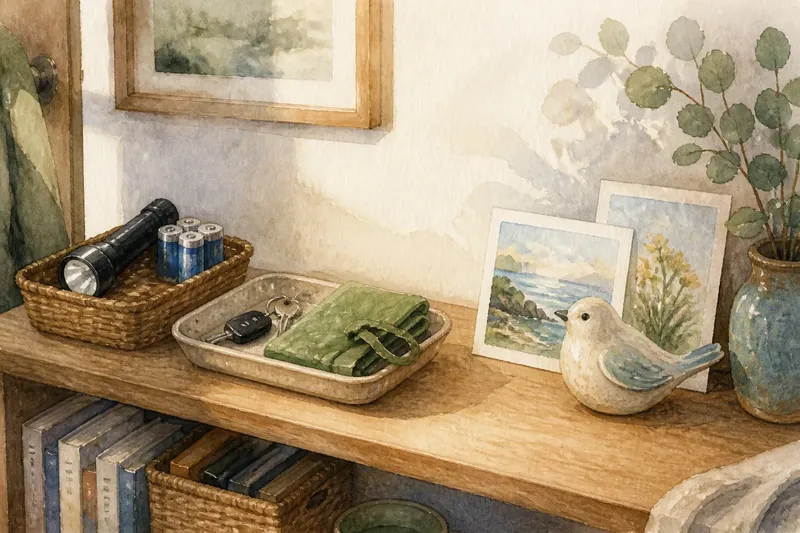
Say you have a small shelf beside the front door. It holds a torch, a bowl for keys, a packet of spare batteries, a folded shopping bag, a little ceramic bird and a stack of postcards. Some things help with leaving the house; others have earned their place because you like looking at them.
Before moving anything, notice the shelf in use. You may reach for the keys and bag on the way out, while the torch and batteries belong together for occasional power cuts. The bird and postcards do not support either task, but their colour and shape might make a pleasing arrangement.
This imaginary shelf has two different kinds of order to offer. One tells you what belongs to a task. The other lets your eye recognise a family resemblance. Neither is inherently tidier: each makes a different connection visible.
When does shared use make the better group?
Group by use when objects are used together, or when finding one naturally leads you to look for another. A torch beside its batteries is a useful pairing. So are a shopping bag near the keys, if both are picked up before leaving.
Shared-use grouping is especially helpful for small, repeated routines. It reduces the mental search: instead of scanning every object, you look at the place where the relevant task lives. A tray, shallow box or small basket can mark that place without requiring matching containers throughout the room.
There is a limit. A shelf arranged entirely around tasks can feel like a row of miniature supply stations, even when the room is meant for relaxing. It can also gather unrelated items simply because they are used at the same time. The shopping bag and keys may belong together; the ceramic bird does not need to join them just because it sits nearby.
When does visual similarity matter more?
Choose visual similarity when the shelf is meant to be looked at, or when you want to notice a pattern among separate objects. Similarity can come from colour, material, shape or scale: pale paper, rounded ceramic, woven textures or objects with a narrow upright form.
On the imaginary shelf, the bird and a few postcards might make a calm display if their colours echo one another. The batteries, however, need not be included just because their packet has the same blue as a postcard. A visual group is strongest when the resemblance feels deliberate rather than accidental.
This arrangement can also help a collection feel coherent without making every item identical. A wooden bowl, a small carved animal and a framed print might share warm tones while each keeps its own character. Leave some breathing room so the common feature can register; filling every gap can turn a pattern into visual noise.
How can you decide what belongs together?
Should objects used together stay together?
Usually, if the connection is frequent and the items fit comfortably in the same place. Keep a torch with its batteries when you want to find both during the same task, but do not force an awkward or crowded grouping.
Can different objects form a visual group?
Yes. A shared colour, material or outline can connect objects with unrelated purposes. Pick one visible trait at a time, so the shelf reads as a pattern rather than a collection of competing similarities.
What if one object belongs in both groups?
Give it a home that supports its most important role, then let nearby objects provide the secondary connection. For instance, a bright shopping bag can stay with the keys for leaving while echoing the colour of a displayed postcard.
How can you tell if the arrangement works?
Use the shelf during an ordinary routine and notice whether you can find what you need without moving other things. Then look at it from the place where you usually sit or enter the room; a display that makes sense only up close may need more space between groups.
What changes in the imagined shelf?
In this invented situation, you decide that the shelf’s main job is to support leaving the house while still offering a small, welcoming display. You place the keys and folded bag in a shallow tray near the edge, where they are easy to pick up. The torch and batteries sit together in a compact basket at the other end.
Next, you keep the ceramic bird with two postcards whose colours suit it, leaving a strip of open shelf between the display and the practical items. The expected observable result is straightforward: on the way out, the keys and bag are visible together; when you pause in the room, the bird and cards read as a small visual set. Nothing has to serve both purposes equally.
The lesson is not to sort every object into a permanent category. It is to make the shelf’s strongest relationships legible. If you later use the torch more often, its place near the door may matter more than its display value; if the postcards change, the bird can remain a favourite without being tied to them.
What is not worth the effort?
It is rarely useful to make every container match, label a small shelf like a storeroom, or search for a perfect visual theme before putting anything away. Start with the objects’ actual connections and adjust only where confusion or clutter appears. Follow any product instructions for storage where they apply, and local requirements where relevant.
When deciding how to group things on a shelf, begin with the experience you want: quick access, a pattern to notice, or a modest balance of both. A useful arrangement lets you reach for what belongs together and gives the eye a reason to linger, without asking every object to tell the same story.