The Hinge Between Parts: Why a Joint Changes What Each Piece Can Do
See how a joint connects separate parts, permits selected movement and limits the rest, from a book cover to a door, folding chair and paper fan.
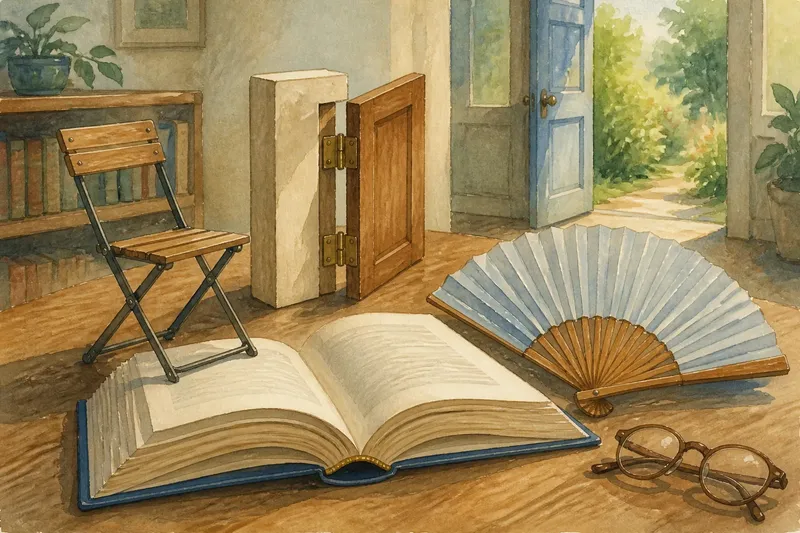
A joint changes what each connected part can do: it holds two pieces together while allowing some movement and resisting other movement. A book cover, for instance, stays attached to its pages but can swing open, fold shut and pause at different angles. The hinge is not merely a link; it shapes the relationship between the parts.
That simple arrangement appears in doors, folding chairs, spectacles, paper fans and even the bend between a finger and a hand. Looking closely at a joint helps explain why connected objects can move as a whole without becoming a single rigid piece.
What does a joint do between two parts?
A joint maintains a connection while defining how the connected parts may move in relation to one another. It can keep them aligned, prevent them from drifting apart, and still permit turning, bending, sliding or folding.
Take a hardback book. Its cover and pages are separate parts, but the spine connects them. The pages can turn while the cover opens away from the stack. The connection makes those actions possible together; it also limits them. The cover cannot move freely in every direction, and the pages cannot simply travel away from the book.
That combination is easy to miss because we often name the whole object rather than its relationships. Yet a book without a flexible connection between cover and pages would behave more like a rigid board. The joint gives each part a particular role: the cover protects and opens, while the pages remain gathered and turn within it.
How does a hinge allow movement without letting parts separate?
A hinge keeps parts connected around a shared line or region of motion. In a household door, the hinge lets the door rotate relative to the frame. It does not let the door slide across the wall or lift away as part of an ordinary opening movement.
The same principle can be seen in a book spine, though its construction differs from a metal door hinge. The spine flexes as the covers open and close, while the binding holds the pages in relation to the covers. In both cases, the connection channels movement instead of allowing every possible movement.
Imagine a child making a paper fan from folded paper and a small fastener at its base. The starting point is a set of folded strips that would otherwise lie together. If the strips are joined at one end, they can spread outward from that point and gather again; the visible result is a fan that opens into a broad shape but remains connected at its base. The joint gives the parts a shared pivot and a recognisable pattern of motion.
What movements can a joint permit or restrict?
A joint’s character becomes clearer when you ask what it permits and what it rules out. A book cover can open and close, but it is not intended to twist like a cloth ribbon. A folding chair can collapse for storage, yet its connections help keep its frame arranged when it is open.
Useful questions include:
- Can the parts turn? A door hinge allows rotation around its attachment.
- Can the parts bend? A flexible book spine changes shape as the covers move.
- Can the parts slide? Some connections allow one piece to move along another, while others hold them in place.
- Can the parts move in several directions? A soft connection may allow more varied movement than a fixed pivot.
- What stops the movement? The edge of a cover, the shape of a frame or the connection itself may set a limit.
These questions describe an object without requiring specialist vocabulary. They also explain why two joints that look similar can produce different behaviour: their materials, shape and arrangement may permit different motions.
Why can the same parts behave differently with another joint?
Because the connection determines how the parts meet and move, changing it can change the whole object’s behaviour without changing its main pieces. A cover attached along a flexible spine can open widely; the same cover fixed rigidly to a stack of pages would not serve the same purpose.
Consider a folding chair. Its seat, legs and back are recognisable parts, but the joints let them shift between an open arrangement and a folded one. If those connections were immovable, the chair might still stand, but it would lose its folding function. If they were too loose to keep the parts aligned, the chair would no longer hold a useful shape.
This is why a joint is more than a meeting point. It is part of the design’s logic: it balances connection with freedom, and movement with restraint. The parts take on different possibilities because they are connected in a particular way.
What questions help you understand a joint?
What is connected to what?
Name the parts on either side of the joint, such as a door and its frame or a cover and its pages. This makes it easier to see which part moves and which part provides a point of reference.
Which movement is easiest to notice?
Look for turning, bending, folding or sliding during ordinary use. A book opening on a table makes its spine’s bending action easier to observe than a closed book does.
What movement is prevented?
Notice what the parts cannot do while they remain connected. A door hinge allows a door to swing, but the door does not normally travel sideways across the frame.
What changes when the joint reaches its limit?
Watch for a cover lying flat, a fan fully spread or a chair fully opened. That point reveals how the joint’s range affects the shape and use of the whole object.
When is it not worth inspecting the joint closely?
You do not need to analyse every connection in an object. If you only want to open a book or sit on a chair, a detailed account of its joints may add little. A quick look is most useful when a movement seems surprising, when a part folds or turns in a distinctive way, or when you are trying to understand why an object holds one shape rather than another.
For a loose hinge or a damaged binding, avoid forcing the parts to move just to see how they work. The appropriate care depends on the object and its materials; for a valuable or fragile item, a qualified repairer can advise on suitable handling.
How does noticing a joint change what you see?
Once you notice the joint, an ordinary object stops looking like a collection of pieces simply placed together. You can see the relationship that makes its actions possible: a cover opens because it remains connected to the pages, a door swings because its hinge channels movement, and a fan spreads because its strips share a pivot.
The next time you open a book, notice both what moves and what stays connected. That small observation captures the central idea of a hinge between parts: a joint does not just bring pieces together; it gives their relationship a direction, a range and a purpose.